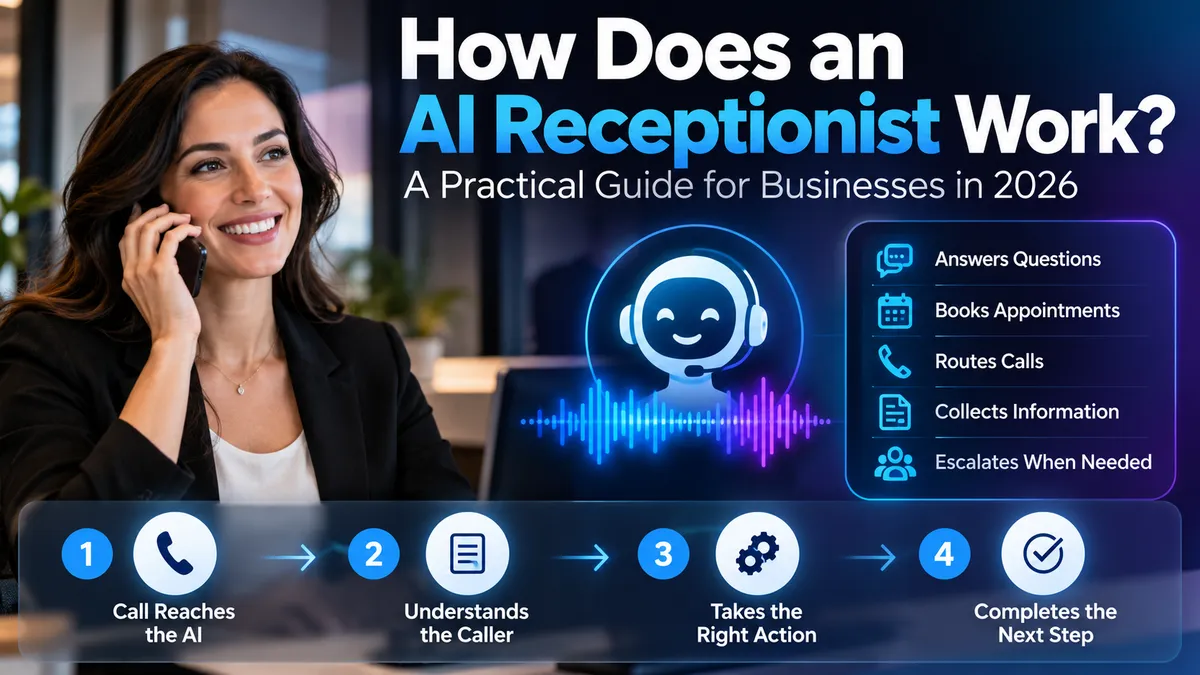
How Does an AI Receptionist Work? A Practical Guide for Businesses in 2026
How Does an AI Receptionist Work? A Practical Guide for Businesses in 2026
Information and provider capabilities referenced in this article were reviewed in October 2026 and may change over time.
Quick Answer
An AI receptionist is a voice-based system that answers business phone calls, understands what the caller needs, responds using approved business information, and can take actions such as scheduling an appointment, collecting information, routing a call, or escalating to a person.
From the caller’s perspective, the experience can feel straightforward:
Call → Conversation → Action → Next Step
Behind the scenes, several systems work together in real time to make that happen.
The most useful way to understand an AI receptionist is not to think of it as “a robot answering the phone.”
Think of it as a configured call-handling system that combines conversation, business knowledge, rules, and actions.
What Happens When Someone Calls?
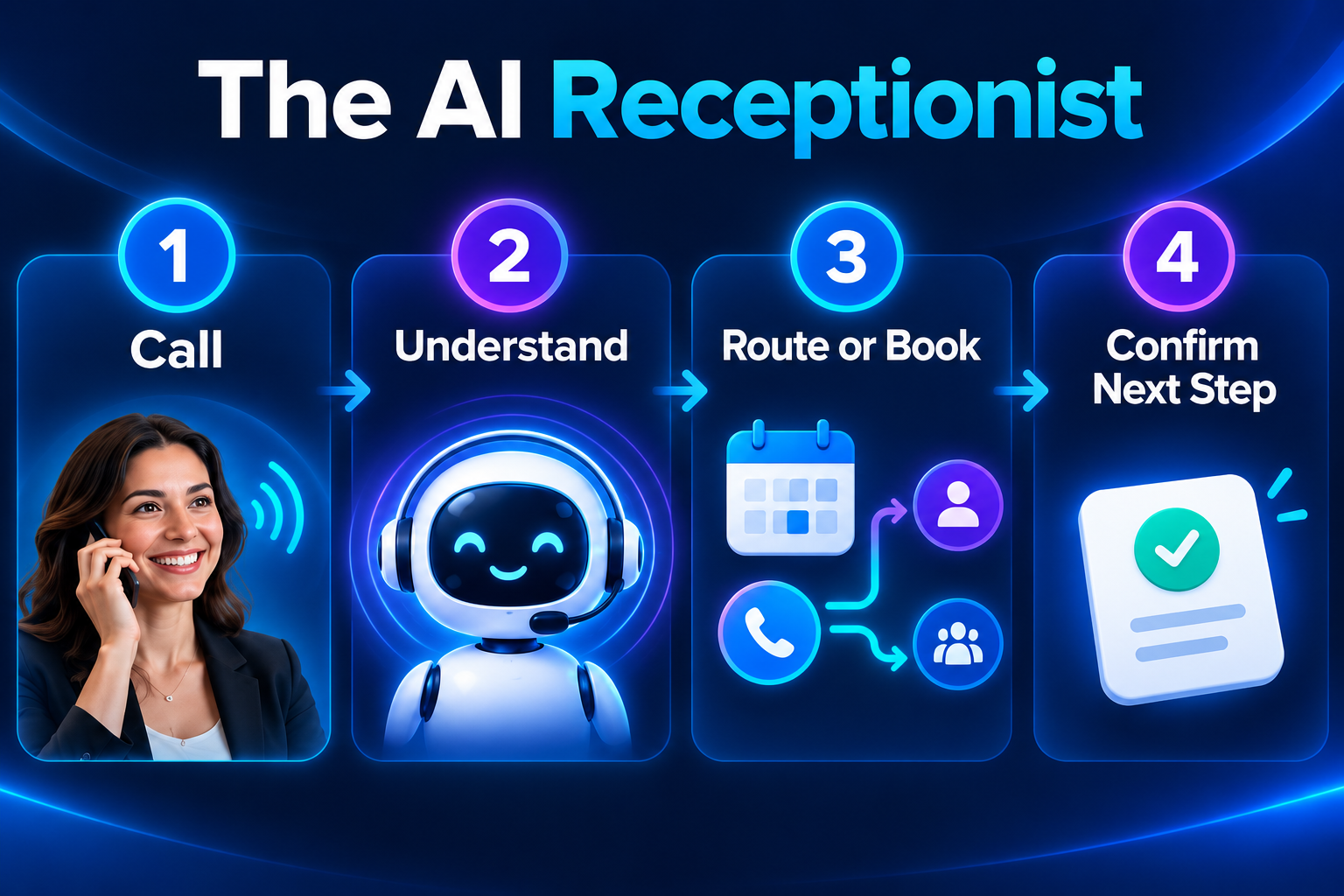
A typical AI receptionist workflow looks something like this:
1. The call reaches the AI
The caller dials your business number. Depending on the setup, the call may route directly to the AI or reach it through call forwarding or another phone configuration.
2. The system listens to the caller
Speech-recognition technology converts the caller’s spoken words into information the AI can interpret.
3. The AI determines what the caller needs
The system evaluates the conversation using its instructions, business knowledge, call rules, and available actions.
The caller might be asking:
what time the business closes
whether a service is offered
whether an appointment is available
to speak with a specific department
to leave information for a callback
what to do after hours
4. The AI responds
The system generates an appropriate response and speaks it back to the caller in real time.
Modern AI receptionist systems typically combine speech recognition, language-model reasoning, text-to-speech, and integrations or actions that allow the system to do more than simply answer questions. Innova AI
5. The AI takes the next action
Depending on how the system is configured, that may include:
answering an approved question
collecting caller details
checking appointment availability
booking an appointment
routing or transferring the call
taking a message
escalating the conversation
ending the call appropriately
This is where an AI receptionist becomes more useful than basic voicemail or a traditional phone menu.
Where Does the AI Get Its Information?
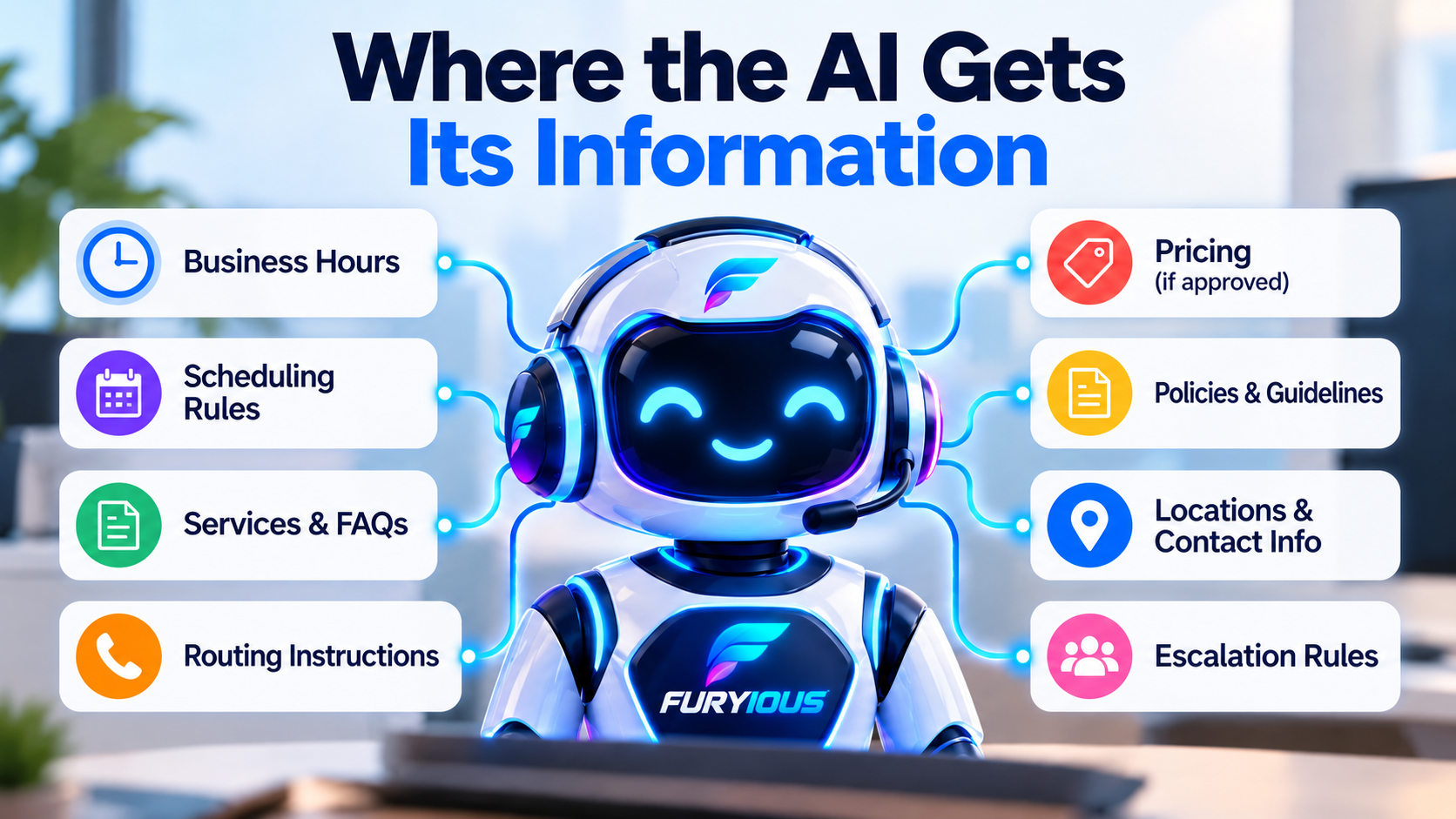
An AI receptionist should not simply invent answers.
A properly configured system works from business-specific information and instructions.
That information may include:
business hours
services
locations
frequently asked questions
scheduling rules
approved pricing information
routing destinations
escalation instructions
policies
caller information requirements
The quality of that information matters.
If the business knowledge is incomplete, outdated, or poorly structured, the AI can only work with what it has been given.
That is why implementation matters as much as the underlying technology.
How Does Appointment Booking Work?
Appointment booking is one of the most common AI receptionist use cases.
In a properly connected system, the AI can ask the caller the required questions, check available times, follow scheduling rules, and book an appointment into the connected calendar.
The important part is that scheduling is not just a conversation.
The system needs rules.
For example:
Which calendar should be used?
Which appointment types can be booked?
How long should each appointment be?
What times are available?
How far in advance can someone book?
What caller information is required?
What happens if no suitable time is available?
Current AI receptionist systems increasingly connect directly to live calendars and other business systems rather than simply telling callers to visit a website later. Open Lines AI
How Does Call Routing Work?
Not every caller should follow the same path.
A business may want:
New customer → intake or appointment booking
Existing customer → customer service
Urgent request → specific person or department
After-hours caller → message or escalation
Unsupported request → human handoff
An AI receptionist can follow those routing rules when they are clearly defined and properly configured.
This is one of the biggest differences between a simple automated greeting and a real Voice AI system.
The greeting is easy.
The routing logic is where the business process begins.
What Happens When the AI Does Not Know the Answer?
A good AI receptionist should have defined boundaries.
If the system does not have enough approved information to answer confidently, the correct response is not to guess.
Depending on the configuration, it may:
say it does not have that information
collect a message
transfer the caller
escalate the call
offer another next step
This is why businesses should ask a provider:
What happens when the AI reaches the edge of what it knows?
The answer to that question often tells you more about the quality of the implementation than a perfect demonstration call.
What Happens After the Call?
The conversation itself is only part of the workflow.
Depending on the system and integrations, the business may receive or store information such as:
caller name
phone number
reason for calling
appointment information
message details
call summary
transcript
routing outcome
follow-up requirement
Some AI receptionist platforms can connect this information to calendars, CRM systems, inboxes, or other business tools. Frontivo.io
The exact workflow depends on the implementation.
Is an AI Receptionist the Same as an IVR or Phone Tree?
No.
A traditional phone tree usually requires callers to navigate fixed menus:
“Press 1 for sales.”
“Press 2 for support.”
An AI receptionist uses conversational interaction instead.
A caller can explain what they need in normal language, and the system attempts to determine the appropriate response or next action.
That does not mean AI should replace every routing system or every human interaction.
It means the caller experience can be more conversational and flexible than a fixed menu when the system is designed correctly.
What Can an AI Receptionist Usually Handle?
Depending on the business and configuration, common Voice AI workflows may include:
answering inbound calls
handling routine questions
collecting caller information
booking appointments
routing and transferring calls
supporting after-hours coverage
following defined escalation rules
These are configurable capabilities, not universal guarantees.
The system still depends on accurate business information, working integrations, clear rules, and proper testing. Furyious’s own approved Voice AI architecture is built around those same bounded capabilities. Furyious_Prospect_Intelligence_…
What Should an AI Receptionist Not Handle Automatically?
There are situations where human involvement may still be appropriate.
Examples can include:
emotionally sensitive conversations
unusual exceptions
high-risk situations
disputes
situations requiring significant judgment
requests outside the approved business knowledge
conversations the business specifically chooses to reserve for people
The goal should not be:
Make the AI handle everything.
The better goal is:
Define what the AI should handle well, and define what happens when it should not.
What Makes One AI Receptionist Better Than Another?
The software matters, but implementation often matters just as much.
Two businesses can use similar underlying Voice AI technology and still produce very different caller experiences.
The stronger implementation usually has better answers to questions like:
Is the business knowledge accurate?
Are scheduling rules clear?
Are transfer destinations correct?
Is escalation defined?
What happens after hours?
What happens if a transfer fails?
What information should be collected?
What should the AI never say?
How is the system tested before launch?
That is why the difference between buying software and deploying a working Voice AI system matters.
If you want a deeper comparison of those implementation models, see our AI Receptionist Cost in 2026: DIY Software vs Managed AI vs Human Answering guide.
Where Furyious Fits
Furyious AI Systems approaches Advanced Voice AI as a managed implementation rather than simply access to software.
Depending on the client configuration, a Furyious Voice AI system may support:
inbound call handling
routine approved questions
caller information capture
appointment booking
routing and transfers
after-hours coverage
client-defined escalation
Those workflows are configured around the individual business and tested against its approved information and rules. Furyious_Prospect_Intelligence_…
The objective is not to make AI sound impressive.
The objective is to build a call-handling system that knows:
What it should answer.
What action it should take.
When it should escalate.
What should happen next.
The Bottom Line
An AI receptionist works by combining real-time voice technology with business knowledge, instructions, and connected actions.
At its simplest:
Caller speaks → AI understands → AI responds → AI takes the appropriate next step
But the real value is not simply that the AI can carry on a conversation.
The real value comes from what happens around that conversation:
accurate business knowledge
defined call workflows
scheduling rules
routing
escalation
integrations
testing
If those pieces are poorly designed, even sophisticated AI can produce a weak caller experience.
If they are designed well, Voice AI can become a practical part of how a business handles routine inbound conversations.
Want to See What Advanced Voice AI Could Look Like for Your Business?
Furyious builds managed Advanced Voice AI systems around your business information, call flows, scheduling requirements, routing rules, and escalation logic.
Book a Voice AI Consultation
Learn More About Furyious Advanced Voice AI
Sources
Innova AI — How Does an AI Receptionist Work?
Technical walkthrough covering call routing, speech recognition, AI reasoning, voice generation, and integrations. Innova AI
Frontivo — How AI Receptionists Work
Explains the real-time workflow from incoming call through business knowledge, actions, scheduling, transfers, and call summaries. Frontivo.io
Open Lines — What Is an AI Receptionist?
Plain-language explanation of answering, understanding caller intent, taking actions, scheduling, and reporting. Open Lines AI
FrontDesk — How Your AI Receptionist Works
Documents the connection between speech recognition, language models, text-to-speech, business configuration, calendar actions, and post-call records.