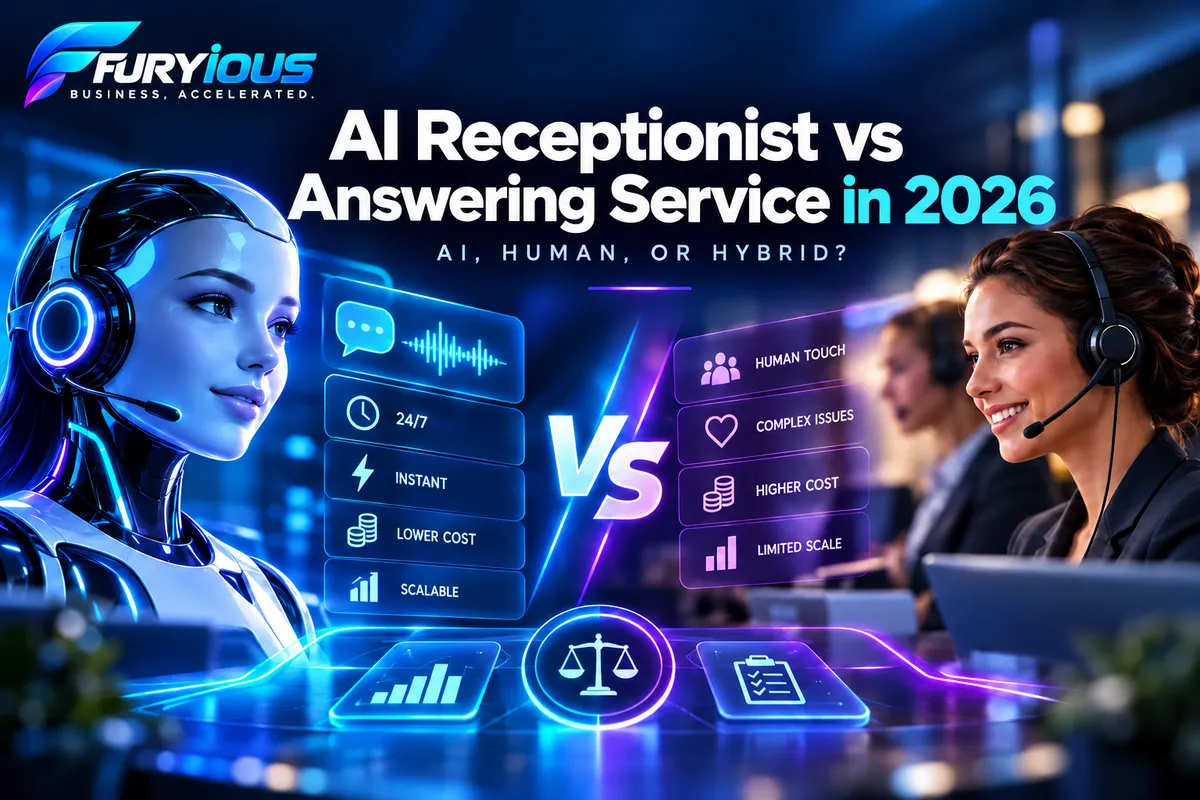
AI Receptionist vs Answering Service in 2026: AI, Human, or Hybrid?
Quick Answer
AI receptionists, human answering services, and hybrid models can all handle business calls—but they are designed for different kinds of work.
AI tends to fit best when calls are structured and repeatable: answering routine questions, collecting information, scheduling appointments, routing calls, and handling defined after-hours workflows.
Human answering tends to fit best when conversations regularly require judgment, reassurance, flexibility, or handling unexpected situations.
Hybrid can make sense when most calls are predictable but some still need a person.
So the better question is not:
Is AI better than a human answering service?
It is:
What needs to happen during the call—and what should happen when the call stops being routine?
What Are You Really Choosing?
This is not simply a choice between a robot and a person.
You are choosing how inbound calls get answered, understood, completed, routed, and escalated.
A useful call-handling system may need to:
answer questions
collect caller information
schedule appointments
route or transfer calls
take messages
handle after-hours requests
escalate unusual situations
That is why the workflow matters more than the label on the service.
AI vs Human vs Hybrid
Need | AI Receptionist | Human Answering | Hybrid |
|---|---|---|---|
Routine FAQs | Strong fit | Strong fit | Strong fit |
Structured intake | Strong fit | Strong fit | Strong fit |
Appointment scheduling | Strong when configured | Strong | Strong |
Defined routing | Strong | Strong | Strong |
Unusual exceptions | Requires escalation | Often stronger | Strong |
Sensitive conversations | May be less appropriate | Often stronger | Strong |
Repeatable workflows | Strong potential | Labor dependent | Strong |
Human intervention | Requires handoff design | Built in | Core feature |
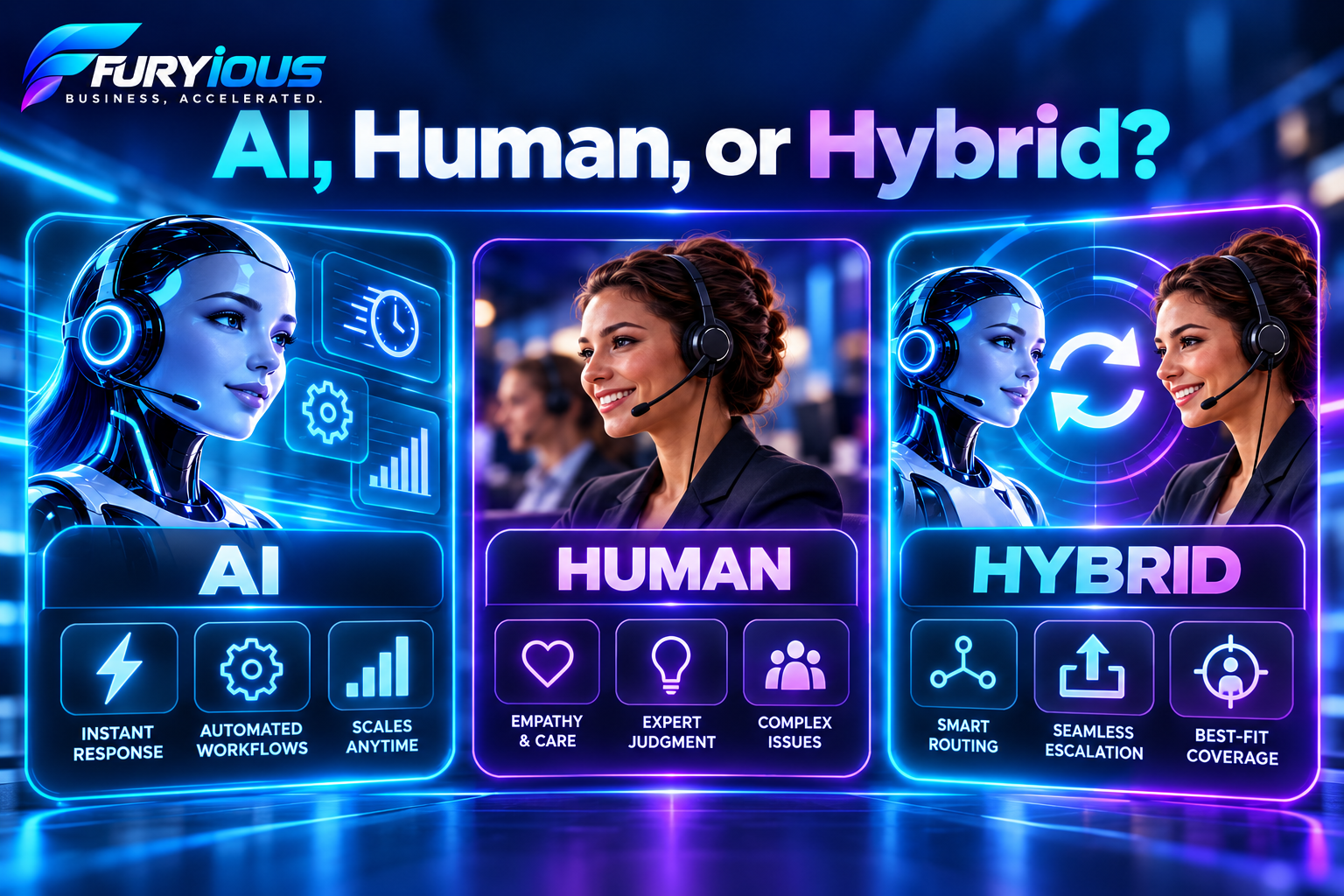
This is a decision framework, not a universal scorecard.
The same type of call may be easy to automate at one business and difficult at another. The difference is often in the rules, exceptions, and next steps.
Where AI Fits Best
AI is strongest when the business can clearly define the question and the next step.
Common examples include:
“What time do you close?”
“Do you offer this service?”
“Can I schedule an appointment?”
“Can you transfer me to the right person?”
A well-configured AI receptionist can use approved business information, scheduling rules, routing instructions, and escalation logic to move those calls forward.
The important phrase is well configured.
Buying AI software is not the same thing as designing a working call-handling system.
Where Humans Fit Best
Human answering remains valuable when conversations frequently require flexibility or judgment.
That can include:
upset or anxious callers
unusual requests
incomplete information
sensitive conversations
unpredictable situations
calls where reassurance matters
It is also outdated to assume human answering services only take messages.
Modern services can provide intake, qualification, scheduling, transfers, bilingual answering, and other business-specific support.
The comparison should be based on what the provider actually does—not a stereotype.
When Hybrid Makes Sense
Hybrid combines structured automation with a human path for selected calls.
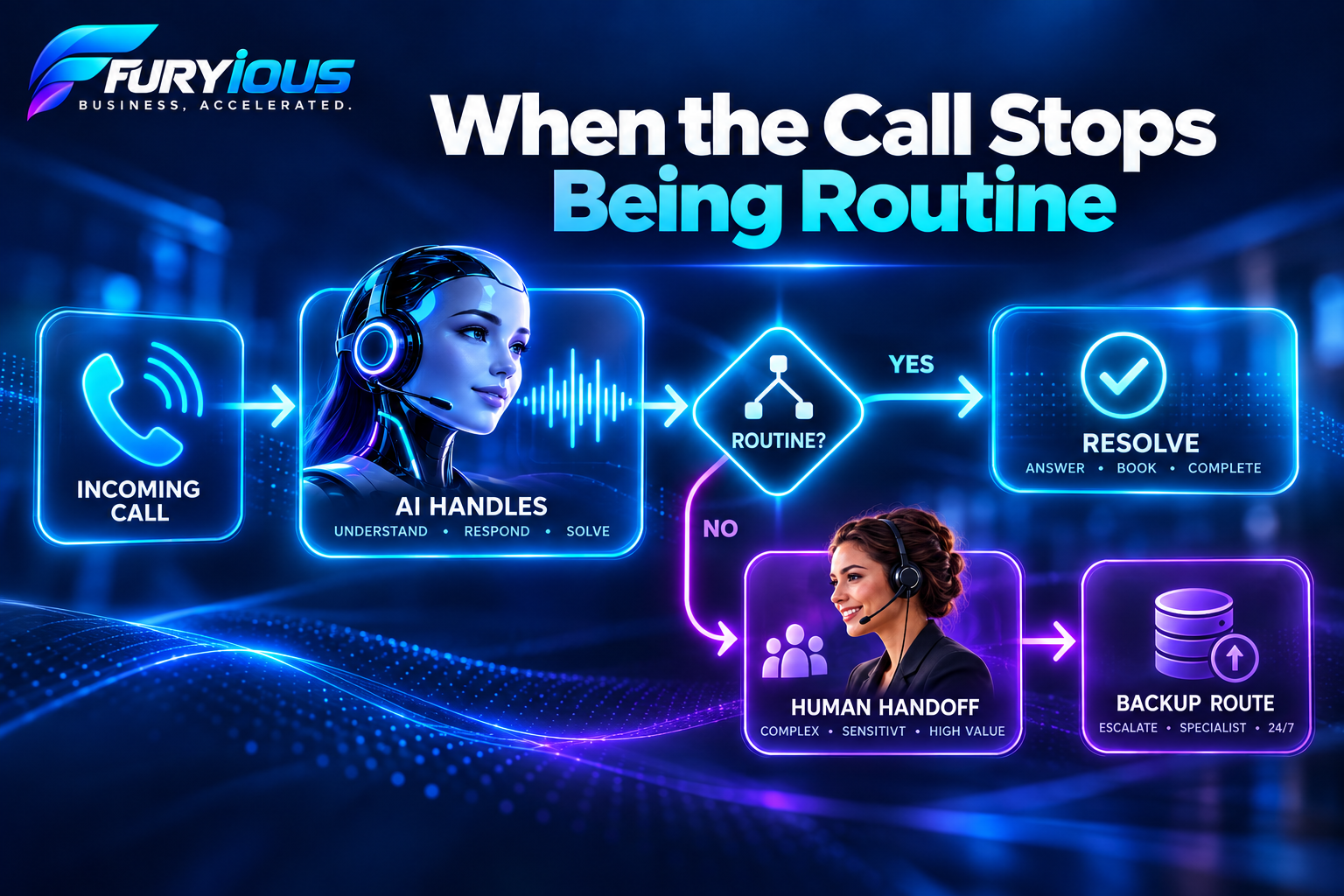
A simple model looks like this:
Routine request → AI handles it
Defined exception → AI escalates it
Human takes over
This can work well when most calls are predictable but not all of them are.
The key is not simply having a transfer button.
The business should define:
Which calls should AI complete?
Which calls should reach a person?
What happens if that person does not answer?
A good hybrid model is designed around those answers before launch.
What Happens When the Call Stops Being Routine?
This may be the most important question to ask any provider.
Most demos show the happy path.
The caller asks something expected.
The system understands.
The right information exists.
The appointment is available.
The transfer succeeds.
Real calls do not always behave that way.
Before choosing a system, ask:
What happens if the AI does not understand?
What if the answer is not in its approved knowledge?
What if the caller asks for a person?
What if a transfer fails?
What happens after hours?
What if an appointment cannot be booked?
What if the conversation becomes sensitive?
A strong system needs a plan beyond:
“The AI answered the phone.”
It needs a plan for what happens next.
Who Owns the System After Launch?
This is where the difference between software access and implementation becomes important.
Someone still needs to define:
approved business information
scheduling rules
routing destinations
transfer behavior
escalation rules
exception handling
future updates
And someone needs to test whether those rules actually work.
So before buying, ask:
Who owns configuration, testing, maintenance, and exception handling after launch?
If you also want to compare the cost differences between DIY software, managed AI, and human answering, see our AI Receptionist Cost in 2026 comparison.
Which Model Fits Your Business?
Consider AI when:
Your calls are mostly repetitive and structured.
Your business can clearly document its answers and rules.
Scheduling and routing are predictable.
There is a defined escalation path when something falls outside the normal workflow.
Consider human answering when:
Calls frequently require judgment.
Sensitive or unusual conversations are common.
Human interaction is an important part of the customer experience.
Consider hybrid when:
Most calls follow predictable patterns, but some still need a person.
You want automation without removing access to human support.
Exceptions can be identified and routed intentionally.
There is no universal winner.
The best fit depends on the calls your business actually receives.
Questions to Ask Before You Buy
Before choosing an AI receptionist, answering service, or hybrid model, ask:
What types of calls can the system actually complete?
Can it schedule appointments?
What information is it allowed to provide?
What happens when it does not know the answer?
Can it transfer calls?
What happens if nobody answers?
How are after-hours calls handled?
Can callers reach a human when appropriate?
Who configures and tests the system?
How do we review whether it is working correctly?
A polished demo matters less than clear answers to those questions.
Where Furyious Fits
Furyious approaches Advanced Voice AI as a managed business system rather than simply access to AI software.
Depending on the business configuration, Furyious Voice AI can support functions such as:
answering inbound calls
handling routine questions using approved business knowledge
capturing caller information
booking appointments
routing or transferring calls
supporting after-hours coverage
following defined escalation rules
Those capabilities are configured around the individual business rather than treated as universal guarantees.
Our implementation philosophy is simple:
Build once. Configure repeatedly. Test consistently.
The current standard Furyious Advanced Voice AI offer is:
$3,000 setup + $750/month
Larger, multi-location, high-volume, or unusually complex implementations may require custom scope.
See How Furyious Advanced Voice AI Works
The Bottom Line
AI is not automatically better because it is automated.
Human answering is not automatically better because a person answers.
And hybrid is not automatically the right compromise.
Start with the calls.
What is predictable?
What requires judgment?
What should happen when something unexpected occurs?
If those questions are answered clearly, choosing between AI, human, and hybrid becomes much easier.
Want to See What Voice AI Could Look Like for Your Business?
Furyious builds managed Advanced Voice AI systems around your business information, call flows, scheduling rules, routing requirements, and escalation logic.
Learn More About Furyious Advanced Voice AI
Sources
Goodcall — Appointment Handling
Goodcall documents configurable appointment workflows including quick answers, booking links, call transfers, and message-taking.
Goodcall — Operator and Routing
Goodcall documents operator handling, human-transfer behavior, and configurable backup actions when a transfer destination does not answer.
Goodcall — Business Knowledge
Goodcall documents the use of business-provided information for conversational knowledge alongside configured actions.
Smith.ai — AI Receptionist
Smith.ai currently offers AI receptionist services with call handling, qualification, scheduling, routing, and optional live-agent escalation.
Smith.ai — Human Virtual Receptionists
Smith.ai currently offers live receptionist services including screening, intake, transfers, and optional appointment scheduling.
Ruby — Virtual Receptionists
Ruby currently offers live receptionist services including 24/7 answering, scheduling, intake, routing, and bilingual call handling.